

If you’ve been told that you or your child has strabismus, you’re probably wondering about treatment options. Vision therapy can provide a functional improvement in many cases of strabismus and help many people achieve better eye alignment and coordination.
Understanding what strabismus (eye turn) is and the treatment options available is crucial for making informed decisions about your or your child’s eye health. It’s important to understand how strabismus can affect not only academic success, but self-esteem and confidence over time. Patients with strabismus can improve visual skills at any age, but treatment with the correct lens, prism and vision therapy can provide improvement before any outward concerns are noticed.
What Is Strabismus?
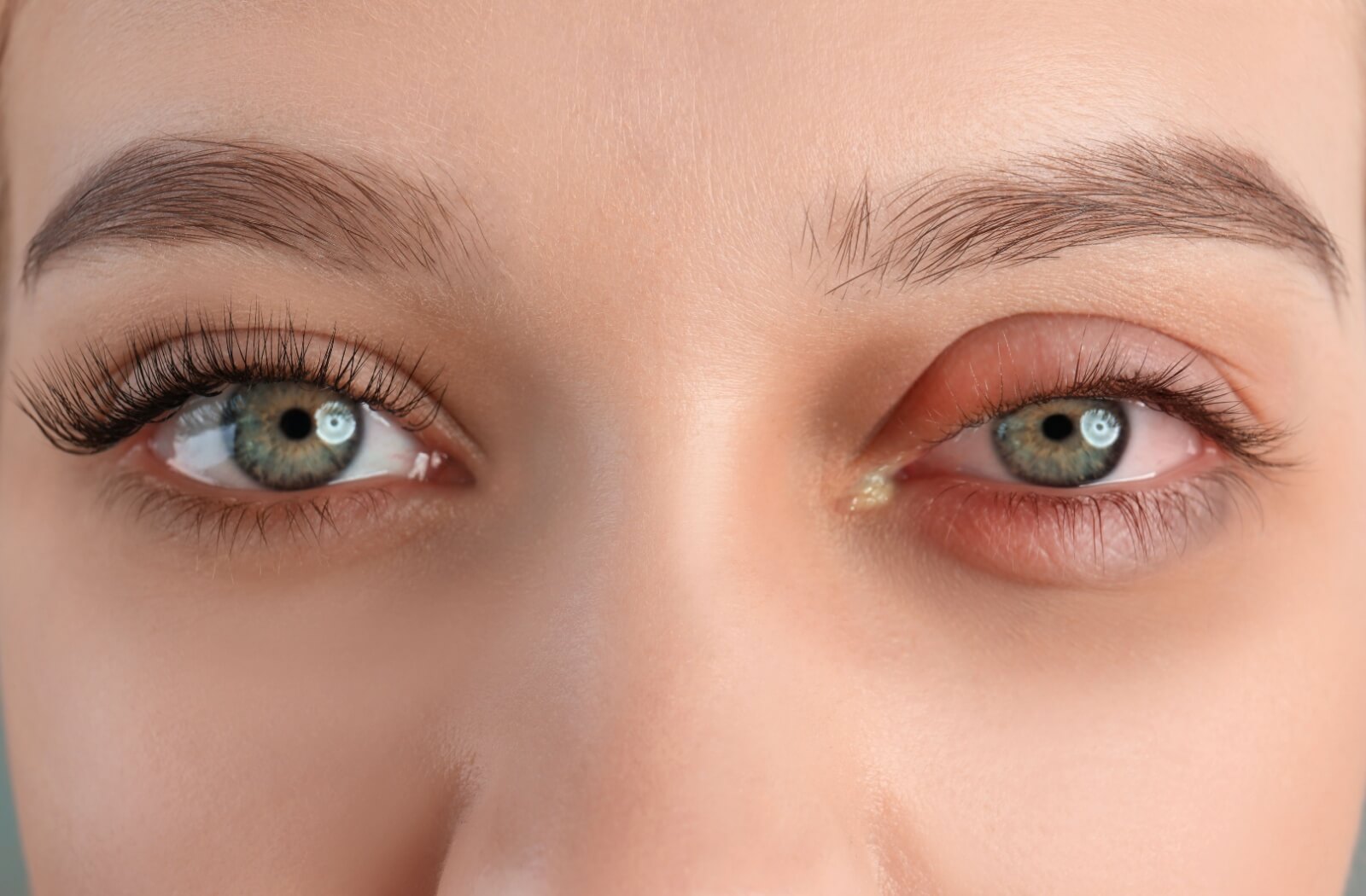
Strabismus is a condition where the eyes don’t align properly when looking at an object. With strabismus, instead of both eyes focusing and being lined up at the same place, one eye may turn inward, outward, upward, or downward while the other maintains proper alignment. This misalignment can be either constant or intermittent, and it may alternate between the 2 eyes. For some with strabismus, the eye turn is only noticeable when tired or when they are looking in a certain direction or distance. Sometimes, a microstrabismus is present that is not noticeable to the patient or parent, but causes visual disruption with blurred vision, difficulty focusing or double vision.
There is more than one way to view and treat strabismus. As a board certified neuro-optometrist who specializes in the function of vision and how it impacts my patients as a whole, I view strabismus as an “eye-brain” connection issue, rather than simply a muscle problem. Surgeons tend to view strabismus as a structural problem where the eye muscles are not working together, so surgery is recommended. I personally do not recommend surgery as a first line of treatment for strabismus, since patients who undergo the surgical route often need multiple surgeries to obtain cosmetic alignment,and still struggle with binocular dysfunction.
There are several types of strabismus, classified by the direction of the misaligned eye:
- Esotropia: One eye turns inward toward the nose
- Exotropia: One eye turns outward away from the nose
- Hypertropia: One eye turns upward
- Hypotropia: One eye turns downward
Symptoms of Strabismus
Recognizing strabismus symptoms enables you to seek treatment sooner rather than later. The most obvious sign is visible eye misalignment, but other symptoms may be less apparent. Common symptoms include:
- Double vision
- Eye strain and fatigue
- Difficulty with depth perception
- Frequent squinting or closing one eye
- Head tilting to compensate for misalignment
- Poor coordination and clumsiness
- Reading difficulties or avoiding near work
Children with strabismus might not complain about vision problems because they’ve adapted to their condition. Their brain may also unknowingly suppress vision in the misaligned eye to avoid double vision, which can eventually lead to amblyopia (lazy eye) if left untreated.
Can Strabismus Be Cured?
The term “cure” suggests a complete elimination of the problem. And while vision therapy can dramatically improve strabismus, whether or not it can be fully cured depends on several factors, including the type and severity of the condition, the age at which treatment begins, and individual responses to therapy.
Many people achieve a functional improvement in eye alignment, eye tracking, and reduction of double vision with treatment through vision therapy. This means the patient’s eyes work together effectively for daily activities, even if perfect alignment isn’t maintained in all situations. Using neuroplasticity, the brain can learn to coordinate the eye more effectively, which improves alignment and significantly reduces symptoms.
Early intervention typically yields better results, but adults can also benefit from vision therapy. The brain’s ability to adapt and learn new patterns of eye coordination, known as neuroplasticity, makes improvement possible at any age, though progress may be faster in younger patients.
What Is Vision Therapy?
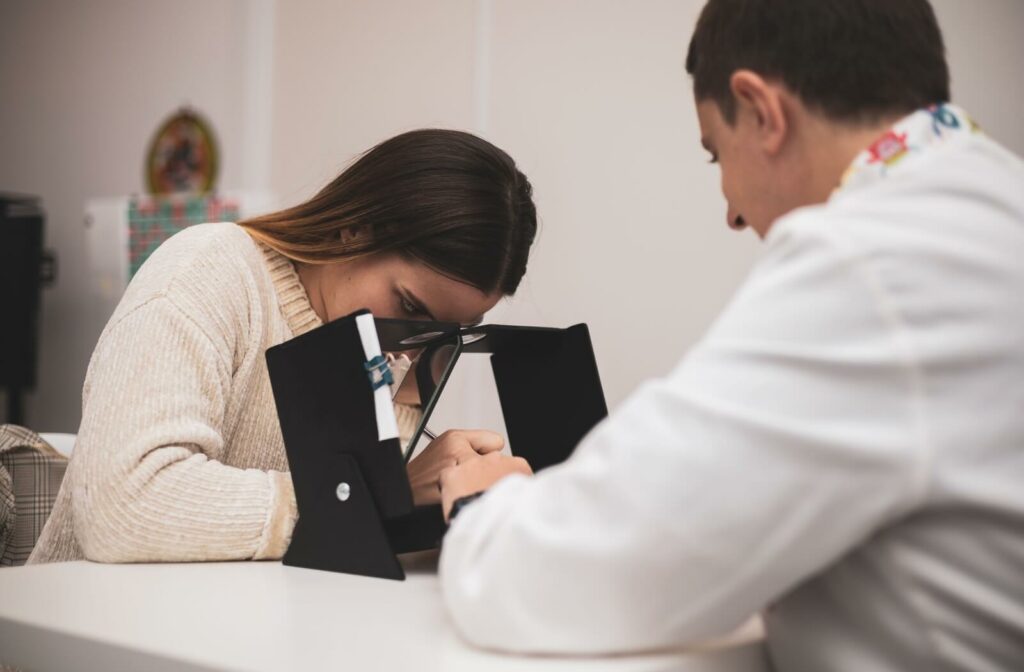
Vision therapy is a customized program of visual exercises and activities designed to improve visual skills and processing. Think of it as physical therapy for your eyes and brain—it trains the visual system to work more efficiently and effectively.
Unlike simply prescribing glasses or contact lenses to correct refractive errors, vision therapy addresses how the eyes work together and how the brain processes visual information. It’s an active treatment that requires participation and practice, but the results can be transformative.
The therapy typically involves a series of exercises performed both in the office with a trained therapist and at home. Sessions may include activities using specialized equipment, such as prisms, filters, lenses, and computer programs, designed to challenge and improve specific visual skills.
What Does Vision Therapy Treat?
Vision therapy addresses a wide range of visual conditions that go beyond simple nearsightedness or farsightedness. The treatment focuses on improving visual skills that affect learning, reading, sports performance, and overall quality of life.
Conditions commonly treated with vision therapy include:
- Strabismus
- Amblyopia
- Convergence insufficiency
- Focusing problems
- Eye tracking difficulties
- Visual processing disorders
- Binocular vision problems
Athletes also use vision therapy to enhance their performance and improve skills like hand-eye coordination, peripheral awareness, and reaction time. Vision therapy isn’t always just about fixing problems—it can optimize visual function for peak performance.
Treating Strabismus with Vision Therapy
Vision therapy for strabismus focuses on training the eyes to work together as a coordinated team. The treatment addresses both the muscular coordination needed for proper alignment and the brain’s ability to process and merge images from both eyes.
The therapy program typically includes exercises to improve basic eye movements and coordination. People might practice tracking objects smoothly, quickly shifting focus between targets, or maintaining steady fixation. These foundational skills are essential before working on more complex binocular coordination.
Schedule a Consultation & Discuss Vision Therapy
If you or your child is dealing with strabismus, don’t wait to explore your treatment options. Vision therapy provides a non-surgical approach to improve eye alignment and visual function.
Vision therapy requires commitment and consistent practice, but the potential benefits—improved eye alignment, enhanced depth perception, reduced eye strain, and increased visual comfort—can impact your quality of life.
Take the first step toward better vision by scheduling a consultation with our expert team at Bella Vision today.